Brazil’s National Dish
This article first appeared in The Weekend Australian January 20-21st 2007.
There’s an old joke that you know you’re Brazilian when you take soccer too seriously, you’re so used to corruption that nothing surprises, and you know how to party. And if the party’s over before 5am, it’s not a party. They also say you’re Brazilian when you’re the loudest person in the room, you eat rice and beans at least seven days a week and you know what feijoada is.
I once lived in a dingy basement flat in London’s Notting Hill. This was when there were still squats there and not Richard Branson. I shared it with a couple of Brazilians, or so I thought. Not until I moved in did I find that I was sharing it with hundreds of Brazilians. It was there I also learned about feijoada, generally regarded as Brazil’s national dish. The name comes from the Portuguese word for bean, feijoa.
Feijoada has similarities to two better-known dishes, bouillabaisse and paella. It’s believed bouillabaisse was devised by French fishermen who, when returning from sea, didn’t want to waste the fish scraps caught in their nets that couldn’t be sold. They would build firers on the beaches and cook up a storm. Today, more refined versions of the stew are served in Michelin-starred restaurants. Likewise, paella (the word derived from an Arabic term for leftovers) was eaten by Spanish peasants, who would cook in the countryside in an open field. They used rice as a base and chucked in whatever was available at the time. Feijoada also comes from such humble origins.
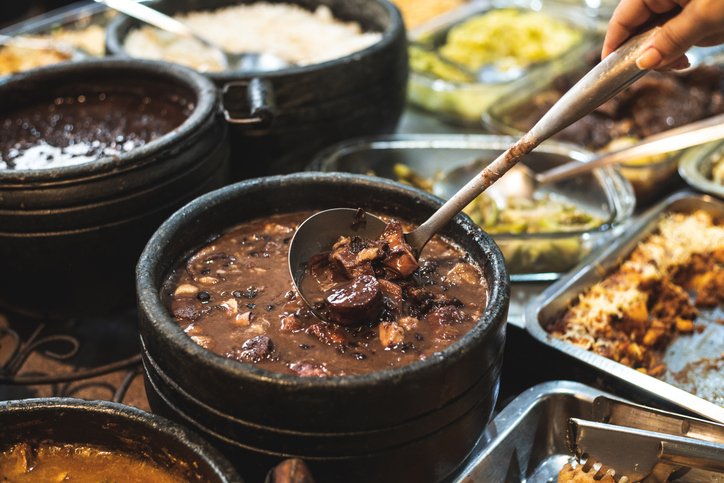
The original dish was invented by African plantation slaves in Brazil more than 300 years ago. It was typically a mixture of beans and smoked and cooked meats flavoured with garlic, onion and spices. The cooks would take unused bits of meat such as pigs’ ears, tails, trotters and tongue, and throw into the dish the black beans used to feed livestock.
The dish has since evolved and is now served every Saturday at the Copacabana Palace Hotel in Rio, one of the most luxurious hotels in South America. It’s also cooked in the streets where the underclass lives, while many Brazilian restaurants have designated feijoada days.
I decided to have a crack at feijoada myself recently and quickly realised the dish would never make it on a Jenny Craig diet plan. This abbreviated simple recipe comes from Maria’s Cookbook, which can be found at www.maria-brazil.org.
Basically, black beans and cured beef are soaked in separate pots overnight. The next morning, drain the beans and boil in a larger pot with the meat, Portuguese chorizo sausage, baby spare ribs and bay leaves. Then, in a separate pan, fry garlic and onion, mash some beans and put the mixture back into the pot to thicken, then season. Continue to simmer gently, adding water as necessary. In a few hours the dish will be ready.
Traditional accompaniments include farofa (a sort of Brazilian couscous), sliced oranges, rice, collard greens and hot pepper sauce.
The ideal way to make feijoada is to plan to spend the morning in the kitchen cooking the stuff and the afternoon in the living room eating it. For drinks, start with a caipirinha, a traditional Brazilian cocktail made from sugarcane liquor, lime and lots of crushed ice. Then move on to beer mixed liberally with lots of colourful banter.